Booklet – “My Cultural Revolution” (18 May 1968 – Salvador Dali)

(Click on image to view PDF of full document)

MY CULTURAL REVOLUTION

by Salvador DALI

MY CULTURAL REVOLUTION

I, Salvador Dalí, an apostolic Roman Catholic, apolitical to the highest degree and spiritually monarchist, I note with modesty and jubilation that all the enthusiasms of today’s creative youth are united around a single virtue: opposition to the bourgeois culture.

The most beautiful and the most profound cultural revolutions were made without barricades, with the insurrectional violence animating solely the spirit, the master of space and time. It is by an excavating process, quite the opposite of barricades, that we can give to the past a means of getting round into the future. It was a rediscovery of fragments of “antique” sculpture that brought about, in the 16th century, the cultural revolution rightly called the Renaissance. All real cultural revolutions must be in contact with the evolution of a new style. The Louis 14th style, which was the apotheosis of the Renaissance, was ruined by the revolution, which was to give a vilifying power to the bourgeoisie. The spherical architectures of Ledoux, intended for the workers in a lyrical vision of the city, came to be abandoned by the skeptical, rational and functional bourgeoisie.

I bring to the new revolution what is mine: that is, my paranoid method of criticism, uniquely adapted, it seems to me, to the felicitously irrational nature of the events unfolding. In the light of this method, I offer the following suggestions:

COLOUR

The colour of modern cultural revolutions is no longer red, but an amethyst colour, evoking the air, the sky, fluidity. This is the colour that corresponds to a change in era. The age of Aquarius, which will determine the next millennium, will see the disappearance of bloodshed. For the time being, we have just assassinated The Fish [“God is dead!”], and the blue sea is tinted by his blood, giving the waves this amethyst colour.

STRUCTURE

Bourgeois culture can only be replaced vertically. Culture will be disembourgeoised only by deproletarising society and turning the functions of the mind upward, by redirecting them toward their transcendent and legitimate divine origin. An aristocracy of the mind must emerge . . .

Practically, it is a matter of quantifying the monuments of bourgeois culture. Not destroying them but, by filling them up with new information, modifying their intention. For example, add to the feet of the Auguste Comte statue a shrine to his St. Clothilde, patron saint of humanity according to positivist folly. This shrine would be an amethyst cradle filled with helium, in which would float, by

rote, the most beautiful naked girls in a state of hibernation for the morose delight of voyeur students, providing a respite from their severely and scientifically controlled hallucinogenic experiences.

For the same price l propose to drape public monuments in certain towns with panoplies created by artists who, like Paco Rabane, are capable of celebrating the coming of the Aquarian millennium.

QUANTIFIED INSTITUTIONS

Add a quantum of libido to anti-pleasure organisations such as UNESCO. Make UNESCO a ministry of public Cretinization, so that we will not lose what has already been done. Blend in some laudable folkloric prostitution, but add to it a strong dose of libidinal and spiritual energy. Thus transform this centre of superboredom into a genuine erogenous zone under the auspices of Saint Louis, chief legislator of venal love.

JUSTICE

Activation of cybernetic-research commissions for the resurrection and glorification of great thoughts that have fallen victim to materialism. Examples: the combinative wheels of Raymond Lulle, the natural theology of Raymond de Sebonde, the treatise of Paracelsus, Guadí’s architecture of Mediterranean Gothic inspiration, Francesco Pyiols’ hyperaxiology, Raymond Roussels’ anti-Jules Verne poetics, the theoreticians of traditional mystical thought, all those who are genuinely inspired. Do not desecrate their unworthy tombs. Dig them up and bury them anew, but in the most sumptuous of futuristic mausoleums, imagined by Nicolas Ledoux.

NOTE

Where the cultural revolution takes place, the fantastic should sprout up.

Paris, Saturday, May 18, 1968.

Tract – “Let’s Continue the Battle in the Street” (17 May 1968 – Mouvement du 22 Mars)

LET’S CONTINUE THE BATTLE IN THE STREET

After Pompidou’s speech, it is clear that our aims and those of the bourgeois state are not the same:

– The police repression of recent demonstrations shows that the state cannot tolerate direct confrontation with the authorities in the streets.

– Appeals for co-operation and to the good sense of the mandarins and various bureaucratic apparatuses, plus the reopening of the Sorbonne, show that the state wants to smother and direct the stream of discontent which has been sparked off by the use of repression by tolerating only the traditional forms of opposition: parliamentarianism, discussion round the fireside of the same type as the Grégoire and Tourée commissions, etc. This form of opposition has already shown its sterility.

– Students, school pupils, the young unemployed, lecturers and workers were not fighting side by side in the barricades last Friday night to save the university for the sake of bourgeois interests: there is a whole generation of future managerial staffs who refuse to be the planners of bourgeois needs or the agents of exploitation and continued repression of the workers.

– The state has presumed to represent the general interest and to play the role of arbiter between the classes: the law (400 arrests) and order (more than 1,000 wounded) apparatus has shown clearly that it represents the interests of only one class and defends only bourgeois order.

– Those in power are biding their time today, they tremble for their future. The spontaneous new forms of confrontation which occurred on Friday are. intolerable to the bourgeoisie: the barricades in the Latin Quarter are not simply an expression of students defending their interests as students, their real point is to encourage others to enter into direct confrontation with the state and its police force. This is why young workers were fighting side by side with students, school pupils and lecturers on the barricades: the battle against the police apparatus is the struggle of every worker.

FROM NOW ON

IT IS IN THE STREET

IN THE FACTORIES

THAT THE STRUGGLE AGAINST BOURGEOIS OPPRESSION AND REPRESSION CONTINUES!

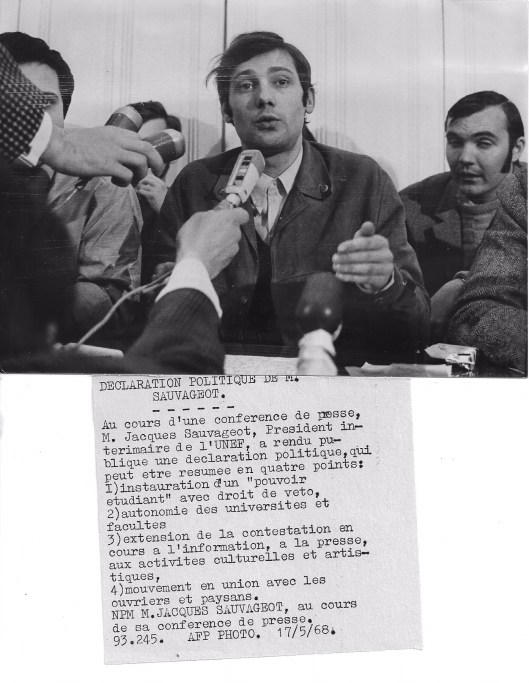
Photo – Jacques Sauvageot press conference (17 May 1968 – Agence France Presse)

POLITICAL STATEMENT BY MR. SAUVAGEOT

During a press conference Mr. Jacques Sauvageot, deputy President of the UNEF, made a political statement, that can be summarised under four points:

1. Institution of “student power” with a right of veto.

2. The autonomy of universities and faculties.

3. The expansion of the current protest movement to the news, the press, and to cultural and artistic activities.

4. A united movement with factory and agricultural workers.

Photographic print

(17 May 1968 – AFP)

17.7 x 13.5cm

Journal – L’Enragé #1 (May 1968 – J.J. Pauvert/Berkeley students)

(Click on image to view PDF of full document)

From rear cover of journal:

This is a reprint of a cartoon magazine put out by the Paris students belonging to the Committee of Action – which organised the resistance activities against the authorities.

It is a non-profit edition, published in solidarity with the revolutionary students of France by the revolutionary students of Berkeley, California.

Translated (freely and roughly, in the spirit of the original) by Ruth Porter.

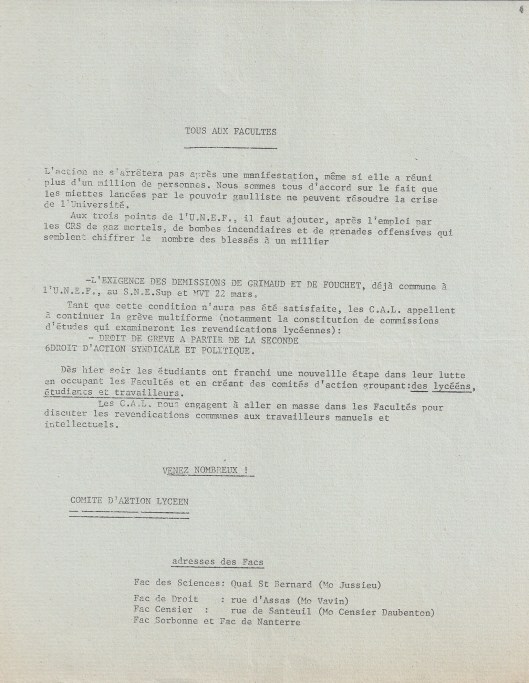
Tract – “Everyone to the Faculties” (14 May 1968 – High School Action Committee)

EVERYONE TO THE FACULTIES

Action won’t cease after a demonstration, even if it brings together more than a million people. We are all agreed that the crumbs thrown by the Gaullist regime can’t resolve the crisis in the University.

After the use of deadly gas, incendiary bombs and attack grenades by the CRS (estimated to have injured a thousand) it’s necessary to add to the three demands of the UNEF:

– THE DEMAND FOR THE RESIGNATIONS OF GRIMAUD AND FOUCHET, already common to the UNEF, SNESup and MVT 22 March.

Until this condition is met, the CAL calls for the continuation of the multifaceted strike (in particular the formation of Study Groups to examine the demands of high-school students)

– THE RIGHT TO STRIKE ARISING FROM THE RIGHT OF UNION AND POLITICAL ACTION

Starting last night the students have reached a new stage in their struggle by occupying the Faculties and setting up Action Committees that gather together: high-school and university students with workers.

The CAL commits us to go en masse to the Faculties to discuss demands together with the blue-collar and white-collar workers.

COME IN GREAT NUMBERS!

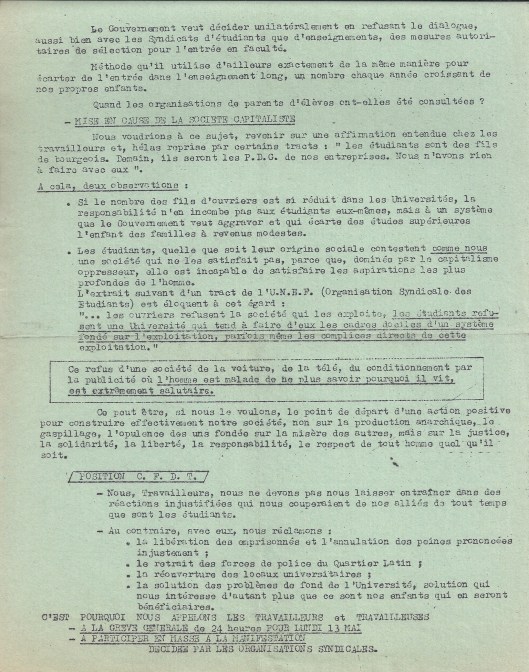
Tract – “One Common Fight” (11 May 1968 – CFDT)

CFDT: One Common Fight

The extremely violent clashes, with blind and bloody repression from the government and a several hours’ long siege by the students, determined to win, are all signs of a deep malaise among the students, but also in the whole of our Society.

THE IMMEDIATE CAUSES:

The attitude of the Government

• in arresting several hundred students at the Sorbonne on Friday, 3 May, although a number of similar meetings had been held previously under the same conditions without harming anyone;

• sending in the police with such brutality that the press largely reported on it;

• in refusing all “overtures”, rejecting every way of defusing the situation such as releasing the imprisoned students;

• the conviction of many student without any proof, under unacceptable conditions. These instant arrests and convictions are new tactics that were inaugurated in Caen against the workers on strike, and which the workers will be the victims of tomorrow.

Actually the large peaceful demonstration organised by the UNEF on Monday 7 May showed that students are perfectly able to keep order themselves provided that the police do not interfere.

THE DEEPER CAUSES:

The ANXIETY of the STUDENTS FACED with their FUTURE.

The university, this enormous graduate-manufacturing machine, is becoming industrialised and now produces graduates without concerning itself with job opportunities for those who are being processed. For example, students who started Human Sciences courses a few years ago, are bitter today when they learn about the scarcity of possible future employment. Nobody has informed them about this state of affairs. Such examples are unfortunately quite common. The question these students are asking themselves – and we, as workers facing our own employment problems, should understand it well, is:

TOMORROW WILL WE BE UNEMPLOYED, OR UNDER-EMPLOYED,?

THE REJECTION OF GOVERNMENTAL AUTHORITARIANISM

There is an important issue, about increasing the number of students, which poses the question of professional career prospects.

The government has unilaterally decided to reject dialogue with both the students’ and teachers’ Unions on the authoritarian methods of selection for entry to the faculties.

This method is used in exactly the same way to exclude a growing number of our own children from entry into further education.

When were the parents’ associations consulted?

SUSPICION OF CAPITALIST SOCIETY

We would like to refer to a statement previously made by workers, and (alas) reproduced in pamphlets “Students are the sons of bourgeois parents. Tomorrow, they will be the managing directors of our industries. We want nothing to do with them.”

Let us add two comments:

• If the number of sons of working-class families is so small in universities, it is the responsibility not of the students themselves, but rather of the system that the government enforces, which tends to shut the door of higher education to children of less well-to-do families.

• Whatever their social origin, students rebel as we do ourselves against a society which does not satisfy them, because it is led by oppressive capitalism and therefore is incapable of satisfying deeper human aspirations.

The following quotation from a pamphlet produced by UNEF is indicative of this view:

“… The workers reject a society which is exploiting them, the students reject a university which attempts to change them into docile executors of a system based on exploration, and sometimes even into direct accomplices of exploitation.”

This rejection of a society of the car, TV and conditioning by advertising where men are sick, not knowing why they are living any more, is extremely healthy.”

If we are determined, this can be the beginning of a positive enterprise to build our new society not on anarchical production, waste, and wealth for same through others’ destitution, but on justice, solidarity, freedom. responsibility, and respect for every man, whoever he is.

POSITION OF THE CFDT• We workers must not let ourselves be led into unjustified reaction which would cut us off from our allies the students.

• On the contrary, with them we demand:

• the freedom of those in prison and the withdrawal of unjust charges;

• the removal of the police from the Latin Quarter;

• the reopening of the universities;

• the solution of the basic problems of the university: we are especially concerned that our children will benefit from the solution.

THIS IS WHY WE CALL ON ALL WORKERS

FOR A 24-HOUR GENERAL STRIKE ON MONDAY 13 MAY,

TO TAKE PART EN MASSE IN THE DEMONSTRATION

decided on by the union organisations.